
BC roofing guide
Roofing rebates in BC: what you can and can’t actually get.
There is no BC rebate for a roof.
Metal, asphalt, standing seam and DIY roofing materials themselves are not rebated. The real financial opportunity is qualifying insulation underneath the roof — and reroofing can sometimes be the ideal time to deal with it.
Rebate programs change. Verify current requirements before starting work.
The short answer: there is no rebate for a roof
Not for metal. Not for asphalt. Not for a steel standing seam, not for a DIY kit, not for anything nailed to the outside of your house.
If you’ve seen a roofing company advertise “government rebates available,” what they’re pointing at is a program that funds something else — usually insulation — rather than the roof itself.
We’d rather just tell you.
No roof rebate
Metal, asphalt, standing seam and other roof coverings themselves are not funded.
What may be funded
Qualifying insulation work underneath the roof.
What is funded is the insulation underneath the roof. And a re-roof is the single best moment in the life of a house to deal with it. That’s the real opportunity, and it rarely gets connected to the roof.
What CleanBC actually pays for
One standard insulation rebate, open to any qualifying household. Separately, there is an income-qualified route — but it is federal, and it does not work like a rebate at all.
The standard BC insulation rebate — Home Renovation Rebate Program
No income test. Rebates are calculated from the R-value of new insulation added and the area covered, with a hard cap per location:
| Where the insulation goes | Rebate rate | Minimum R-value added | Maximum rebate |
|---|---|---|---|
| Attic — flat and cathedral ceiling | $0.02 × R-value added × sq ft | R12 | $900 |
| Exterior wall cavities | $0.09 × R-value added × sq ft | R12 | $1,200 |
| Exterior wall sheathing | $0.09 × R-value added × sq ft | R3.8 | $1,200 |
| Basement / crawlspace walls | $0.09 × R-value added × sq ft | R10 | $1,200 |
| Other (exposed floor, basement header) | $0.07 × R-value added × sq ft | R20 | $1,000 |
Read the rate column carefully. It is not a flat amount per square foot. The rebate is the rate multiplied by the R-value you gain and the area you cover, then capped. Add R40 across a 1,200 sq ft attic and the arithmetic runs past the $900 ceiling — which is why the attic cap is the number that actually matters, not the rate.
Your insulation contractor calculates the exact amount from your attic area and the R-value gained — ask for that number in writing before you commit to anything.
The multi-upgrade bonus
There’s a bonus worth knowing about. If your attic insulation rebate comes to at least $500, it counts as one “bonus-eligible upgrade.” Two bonus-eligible upgrades within 18 months of each other adds a further $300.
So if you’re already replacing windows or putting in a heat pump, the timing is worth planning.
Income-qualified help — Canada Greener Homes Affordability Program
If your household income is modest, this is the first door to knock on, and it does not behave like the rebate above. Rather than paying you back after you spend, it funds no-cost retrofits — insulation, air sealing, heat pumps — installed directly for low-to-median-income homeowners and tenants.
It is a federal program delivered through provincial and utility partners. In British Columbia that means BC Hydro and FortisBC, and BC residents are pointed to their own utility to apply. It expanded to British Columbia in June 2026.
Different shape entirely
Direct install, not a claim form. The delivery organisation handles the planning and the cost of the retrofit. There is no invoice for you to submit afterwards, because you are not the one paying the installer.
Because eligibility is assessed by the delivery partner rather than published as a single national threshold, check with your utility rather than any figure you read on a roofing website — including this one.
What about the CleanBC Energy Savings Program?
It no longer lists an insulation rebate. This is the part worth reading twice, because a lot of pages still say otherwise — and older versions of this article did too.
The current Energy Savings Program requirements, effective for invoices dated on or after 6 July 2026, fund heat pumps, heat pump water heaters, ventilation, health-and-safety work and electrical service upgrades. There is no insulation row and no insulation dollar figure at any income level.
Older program requirements and a great many third-party articles still describe an income-qualified insulation rebate through this program. If you are planning an attic upgrade around that, you are planning around a number that is no longer in the current tables.
Still true: you register before the work
The program requires pre-registration and an eligibility code before upgrades are installed. For applications received on or after 6 July 2026, that code is valid for three months.
Still true: there is a property value ceiling
For registrations on or after 1 April 2026, Income Levels 1 and 2 require a BC Assessment value at or under $1,200,000. Level 3 is capped at $1,820,000.
Still true: the contractor must be registered
Work has to be done by a contractor registered with that program specifically — a stricter requirement than the standard rebate’s contractor network.
None of which helps you insulate an attic today. For insulation, the standard Home Renovation Rebate above is the BC route, and the federal Affordability Program is the income-qualified one.
The part people miss
The gate nobody mentions until it’s too late.
Who installs it matters.
Insulation rebates require the installer to be a member of the Home Performance Contractor Network. Self-installations are not eligible.
That’s the whole gate. Not the material, not the R-value, not the paperwork — who holds the tools.
It catches people constantly. Someone re-roofs, blows in insulation themselves or has the roofing crew do it, then applies and is refused. There is no appeal for this. The work has to be done by an HPCN member verified for insulation services, installed to the Best Practice Guide for Air Sealing and Insulation Retrofits.
The Energy Savings Program is stricter still — it requires a contractor registered specifically with that program.
Metal Roof Factory is not an HPCN member and we don’t install insulation. We’re a roofing company. What we can do is time the roofing around an HPCN insulation contractor so the attic work happens while the roof is open, and so the paperwork is done by someone who can actually sign it.
Why the roof coming off is the moment
Standard vented attic
For a standard vented attic with a hatch, insulation is a Tuesday. You don’t need a re-roof to do it.
Cathedral, low-slope and inaccessible assemblies
Cathedral ceilings and low-slope roofs are the opposite. There’s no attic to crawl into. The only way to add insulation is from the outside, with the roofing removed — or by tearing out the ceiling from inside the house, which nobody wants.
If you have vaulted ceilings, a flat or near-flat section, or a mid-century Island home with exposed beams, the day your roof comes off is realistically the only affordable window you’ll get until the next reroof. Note that the CleanBC table treats flat and cathedral ceilings under the same attic category — the money is there for exactly this situation.
Miss it and you’re insulating over a brand-new roof you just paid for, or not at all.
What disqualifies you
The part most rebate pages leave out. Any one of these and the rebate is gone:
- Your home is heated with wood or pellets. Wood-heated homes are only eligible for a heat pump water heater rebate under the standard program — not insulation. This rules out a lot of Island houses.
- The work needs a “New Construction” or “Addition/Alteration” building permit. Insulation upgrades tied to code compliance on new construction or alterations aren’t eligible.
- The home is under 12 months old, or is an addition that increases square footage, or is classed as “substantially reconstructed” under the Homeowner Protection Act.
- It’s a garage, workshop or outbuilding. Shop roofs don’t qualify. Neither does insulation installed for soundproofing.
- You’re on a strata-held utility account. Accounts must be in the resident’s or homeowner’s name.
- You missed the window. Applications and documentation must be submitted within six months of the invoice date.
- There are rodents or pests in the insulation area. The application won’t be processed until it’s resolved — worth knowing before the crew arrives.
The federal side: mostly closed
Be careful with older articles here, because several widely-cited federal programs are finished:
- Canada Greener Homes Grant (the $5,000 one) — closed to new applicants.
- Canada Greener Homes Loan (the $40,000 interest-free one) — closed 1 October 2025.
The Grant ran from 2021 to 2024, with a final documentation deadline of 31 December 2025. The Loan’s funding is fully committed; 1 October 2025 was the last day to apply. Neither is taking new applicants, whatever an older article tells you.
What replaced them is the Canada Greener Homes Affordability Program — covered further up this page, because for insulation it is now the income-qualified route rather than a footnote.
FireSmart rebates: the one that can put money toward a roof
Everything above still stands: no provincial or federal program pays for a roof. FireSmart rebates are the exception worth knowing about, because they pay for wildfire-risk work rather than energy efficiency — and in some places that work can include the roof.
Some BC local governments and First Nations run FireSmart rebate programs for homeowners, funded through the province’s FireSmart Community Funding and Supports program. Rebates can reach up to $5,000 depending on where you live, and they are capped at 50% of the cost of the work.
On Vancouver Island, the Alberni-Clayoquot Regional District runs one: 50% of eligible costs up to $5,000, with a FireSmart home assessment first — see the ACRD FireSmart program.
Three things decide whether it helps you:
- The assessment comes first. You need a FireSmart home assessment of your property before anything qualifies, and the work has to be what that assessment recommends.
- Roofing is on some lists, not all. Some programs have listed fire-resistant roofing among the eligible upgrades. Others cover vegetation, landscaping and defensible space only.
- Not every community runs one. Funding is limited and can run out for the year.
So check before you plan a roof around it. Contact your local FireSmart coordinator or your local government, and ask whether a program is running where you live and whether it covers roofing.
Source: BC Wildfire Service — Rebates available to help protect your home from wildfire
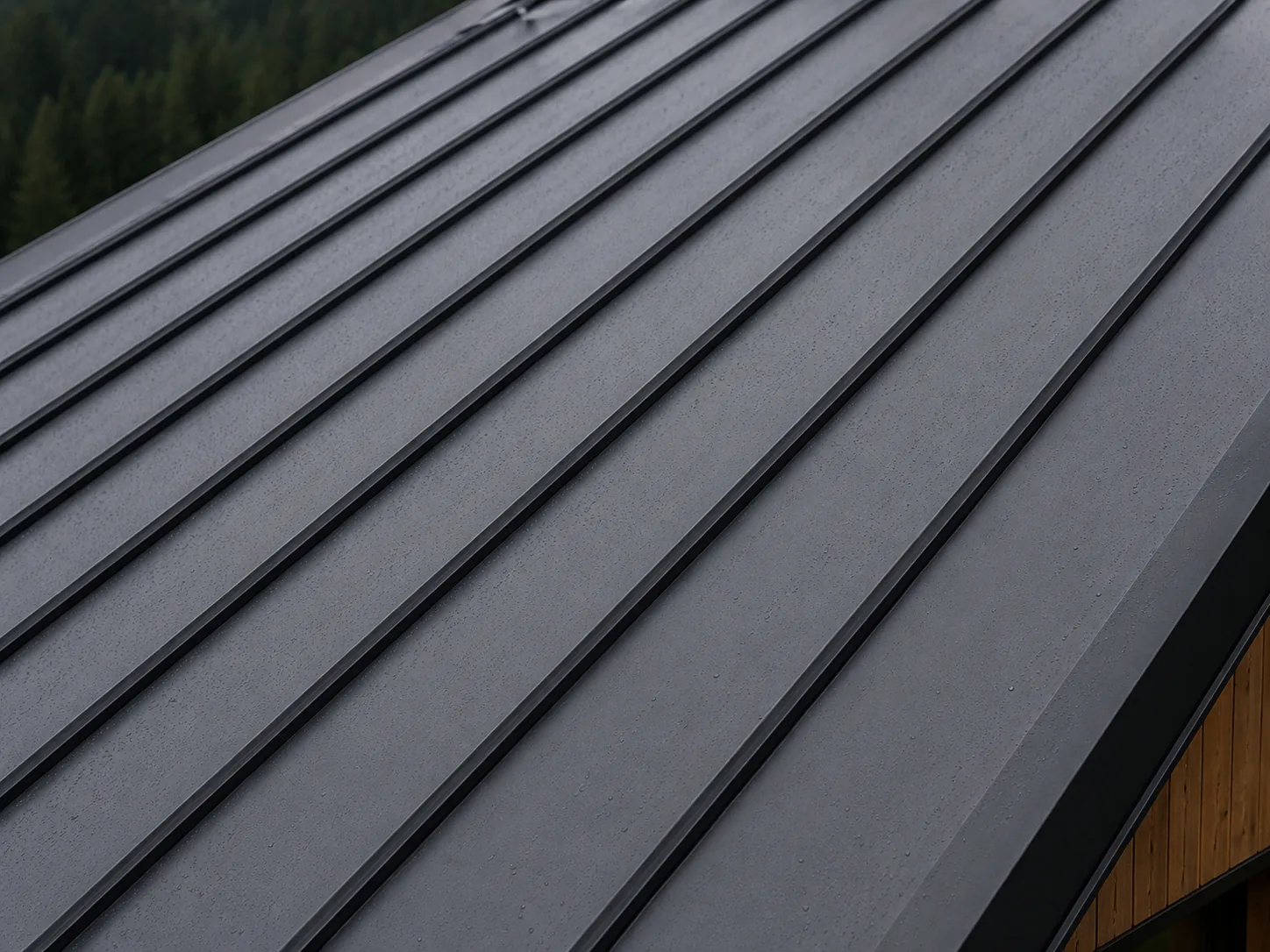
What we won’t claim
We’re not going to tell you a metal roof cuts your energy bill.
You’ll see this claim on roofing websites. We’re not going to make it, and here’s the honest reason.
Reflective metal roofing reduces cooling load. It works by bouncing solar heat away in summer. Vancouver Island is a heating-dominated climate — the overwhelming majority of the energy you spend on climate control here goes into keeping heat in during a wet winter, not keeping it out in August. The saving from a reflective roof surface in this climate is close to nothing.
Under the Competition Act, what matters isn’t whether a claim is technically arguable — it’s the impression the customer is left with. “Metal roofs cut your energy bills” leaves an impression we can’t stand behind on this coast.
The insulation carries that argument, because it does the work. The roof is what protects the insulation and the building for the next several decades.
What a metal roof actually gives you
No rebate attached to any of it. Just the honest list:
- You stop buying roofs
The reason to buy one is that you stop buying roofs. - Non-combustible surface
Relevant if you’re anywhere near an interface area, and worth raising with your insurer directly. - Sheds rain and snow
Rather than holding moss and moisture, which on this coast is most of the battle. - Recyclable at end of life
And typically containing recycled content. - Solar-ready
Standing seam panels accept clamp-on mounting, meaning a future solar array doesn’t require penetrating the roof. - Clean catchment
For rainwater collection, unlike asphalt shingle.
Price your roof in about two minutes
Find your house on the satellite map, outline the roof and see an estimated range straight away. It is an estimate rather than a quote, and you see it before we ask for any details.
Frequently asked
Before you take our word for it
Rebate programs change several times a year, and half the pages ranking for these terms are quoting amounts that expired two program cycles ago. Everything above was checked against the official Better Homes BC program requirements on 19 August 2026.
Last checked against official program information
19 August 2026
Verify current amounts yourself at betterhomesbc.ca, or call a CleanBC energy coach free at 1-844-881-9790. They don’t sell anything.
Then, if your roof needs doing, come talk to us about the roof.
Sources
- BC Hydro — Insulation rebates, Home Renovation Rebate Program (rates, R-value minimums and caps)
- Better Homes BC — Home Renovation Rebate Program requirements (effective for invoices dated on or after 15 May 2026)
- Better Homes BC — Energy Savings Program requirements (effective for invoices dated on or after 6 July 2026)
- Natural Resources Canada — Canada Greener Homes Affordability Program
- Natural Resources Canada — Closed: Canada Greener Homes Grant; Canada Greener Homes Loan status
- BC Wildfire Service — Rebates available to help protect your home from wildfire (FireSmart Community Funding and Supports; checked 30 September 2026)
Need the roof done?
Deal with the insulation at the right time.
Then build the roof for the next few decades.
If your roof is due for replacement, we can talk through the roofing side of the project and coordinate timing around eligible insulation work where appropriate.